OpenAI has introduced OpenAI Frontier, an agent-based artificial intelligence platform designed to automate workplace tasks traditionally handled by humans. The initiative aims to transform corporate software environments by enabling virtual agents to operate across business systems much like real employees.
In the early 2000s, enterprise productivity relied heavily on tools such as Microsoft Office, which required trained users to perform most functions manually, but OpenAI Frontier proposes a different model: AI agents that can directly interact with corporate systems to complete tasks independently.
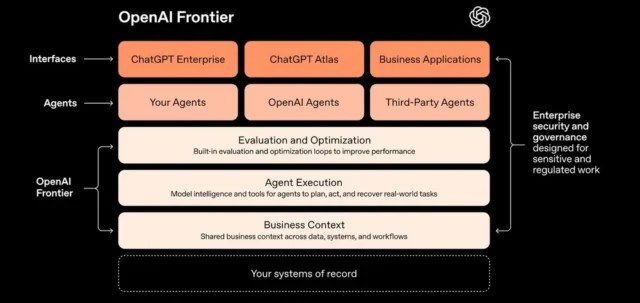
Frontier operates through three main components. First, it connects to enterprise systems to gather shared contextual information. Second, it provides an execution environment equipped with tools that allow agents to perform tasks locally, in the cloud, or across hybrid infrastructures. Third, it includes real-time evaluation capabilities to monitor performance and continuously optimize outcomes.
(Image: OpenAI)
These agents can be deployed through multiple interfaces, including ChatGPT, Atlas browser workflows, or third-party enterprise applications. This flexibility allows organizations to integrate Frontier into existing workflows rather than rebuilding their software ecosystems from scratch.
OpenAI also emphasizes identity and access management; each virtual agent can be assigned its own credentials and permissions, giving administrators precise control over what each agent is allowed to access or modify. This structure supports secure operations across multiple cloud systems and legacy enterprise platforms, helping companies maintain high security standards while automating processes.
In addition to the technology itself, OpenAI plans to provide implementation support for corporate teams adopting Frontier. The company reports that several organizations are already using the platform through early access programs, including HP, Intuit, Oracle, and Uber.
With Frontier, OpenAI is clearly positioning agentic AI as a practical tool for enterprise automation, aiming to reduce manual workloads and streamline operations by embedding intelligent agents directly into business systems. Whether this will become a trend or not in the future, only time will tell.
Filed in . Read more about OpenAI.