Datacenters construction have become one of the most controversial topics in the United States (and elsewhere). People are asking whether the ones already arriving will raise electricity costs, overload the local grid, and bring more polluting generators into their neighborhoods.
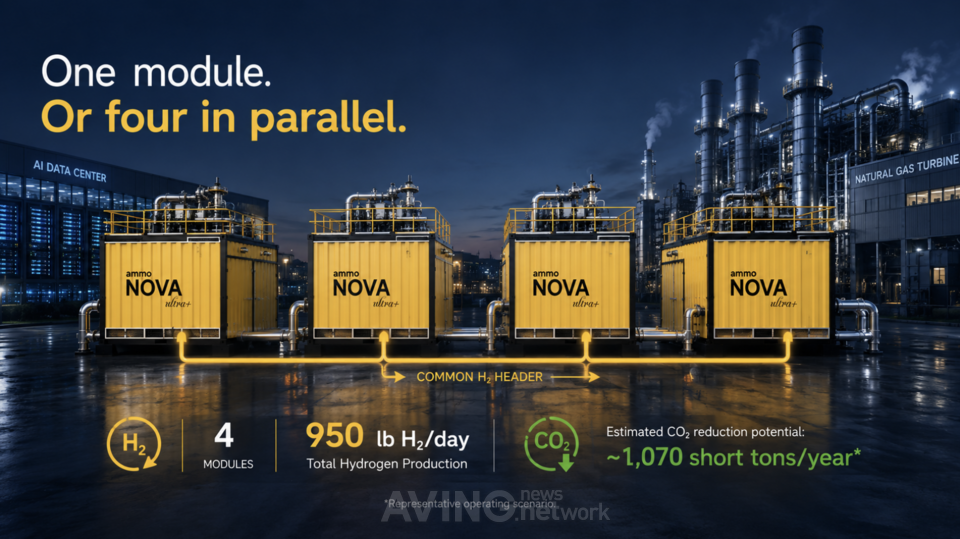
AES Tech, a South Korean startup, is pitching a technical answer to part of that problem: make hydrogen on site from liquid ammonia, then use it to replace some of the natural gas burned in a data center’s power turbines.
That does not magically make the problem completely go away, but it points to a standard worth demanding from the industry. If a facility needs large amounts of new power, it should bring more of that power infrastructure with it and make that infrastructure cleaner and safer than the current backup and supplemental systems many people associate with these activities.
AES Tech’s system, called ammoNOVA, is designed to extract hydrogen from anhydrous liquid ammonia where it will be used. Instead of trucking in compressed hydrogen and keeping it in high-pressure storage, a customer would store ammonia and convert it into hydrogen on demand.
The hydrogen would then be mixed with natural gas and burned in a turbine to make electricity. This is called co-firing. While there are still emissions, this system can reduce them, depending on the blend ratio and the Hydrogen source.
The most important part: the goal is not to power AI at any cost. It is to give a large, power-hungry facility another option when the grid is constrained, one that could reduce its use of diesel and gradually displace some fossil gas.
The International Energy Agency expects global data-center electricity consumption to more than double to roughly 945 terawatt-hours by 2030. In many U.S. communities, the practical consequence is already familiar… new data-center proposals collide with questions about transmission lines, water, local generation and whether residents will end up paying for grid upgrades.
A facility that can produce at least some of its own cleaner fuel during periods of high demand could reduce its dependence on the grid. In theory, that could help keep a local grid from being asked to carry every surge created by an AI campus. It could also be preferable to relying solely on diesel generators during outages or peak events.
In Seoul, I met CEO Jaehong Jeffrey Chun, and one operational detail made the concept more interesting to me: AES Tech can control the electrochemical system’s output in real time, so the hydrogen supply can follow a turbine’s changing fuel demand.
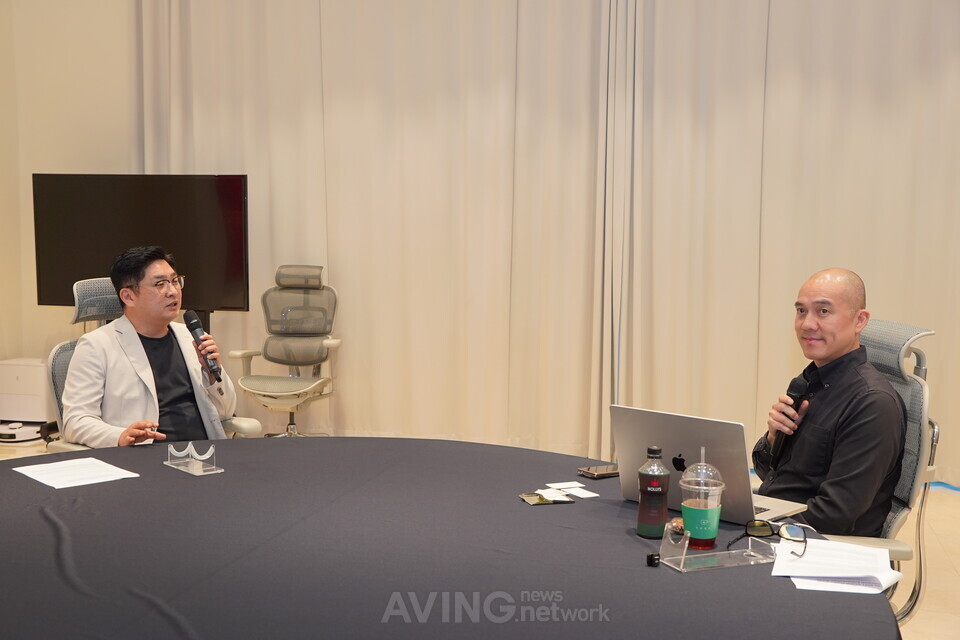
AES Tech CEO Jaehong Jeffrey Chun (left) during an interview with Ubergizmo Editor-in-Chief Hubert Nguyen | Photo by AVING News
Electricity demand fluctuates. When a data center needs more power, a useful on-site system has to respond quickly. AES Tech argues that its electrochemical approach can do that without the high-temperature process normally associated with cracking ammonia.
Ammonia contains nitrogen and hydrogen. ammoNOVA uses electrolysis to separate them, producing hydrogen for the turbine and nitrogen as a byproduct. The company also says its system recovers unused ammonia and purifies the hydrogen.
Hydrogen co-firing itself is technically feasible. Companies like Mitsubishi Heavy Industries reported a test using a 20% hydrogen-by-volume blend in a large gas turbine at a Georgia power plant; it said the blend cut CO₂ emissions by about 7% (PDF link) compared with natural gas alone.
That said, Ammonia is not automatically green and people may ask more questions. The environmental argument becomes compelling only when the ammonia itself has a verifiably low-carbon supply chain and when the hydrogen meaningfully replaces fossil gas.
AES Tech was founded in 2022 and is still early. The company says it is targeting AI-data-center power applications and has submitted ammoNOVA Ultra for CES 2027 Innovation Awards consideration.
Filed in ..