
If your game library is spread across Steam, PlayStation, Xbox, and Nintendo, there is no single place that shows a complete picture. Your playtime, purchases, ratings, screenshots, and achievements are scattered between platforms that were never designed to work together.
Minimap wants to become that missing layer. The South Korean service lets players connect accounts across the major gaming ecosystems and bring their histories into a unified profile. The immediate promise is simple: see more of your gaming life in one place, get recommendations based on games you actually played, and participate in a community built around games rather than general social-media noise.
That is the part gamers should care about first. A player who spent 100 hours on Game X, completed Game Y, or rates narrative RPGs highly has a much clearer taste profile than someone who merely clicked on a genre tag. In theory, that should lead to better recommendations, more relevant discussion, and fewer generic “you may also like” suggestions.
When I met Minimap chief global officer George Jeong in Pangyo (near Seoul), I asked the question that YOU would ask: “why would a regular gamer install this?” His answer was that people want to manage play records fragmented across several platforms, while also having a dedicated place to talk about games. That makes sense, but it also reveals Minimap’s challenge. A unified profile is useful, but becoming a destination people open every day is much harder.
The service works by asking users to voluntarily connect their gaming accounts. Minimap can then organize information such as owned games, playtime, ratings, and other activity into a personal profile, which is arguably a better user experience.
This information can also make game discovery more personal. Rather than recommending a new game because it shares a broad category with something in your library, Minimap can look for more specific signals. A person who finished a difficult action game may be interested in another demanding title; a player who only sampled it for 20 minutes may not be. That distinction is where connected play history could be more useful than the basic preference systems offered by many storefronts.
Minimap is also trying to make ratings more credible. The company has launched a service called Navicritic, which it says limits ratings to users who actually purchased and played a game. That does not eliminate arguments and disagreements about reviews: gaming communities will always find a way to have those, but it could reduce some of the noise from people rating a game they never touched.
There is another user benefit: rewards. Minimap says people who choose to participate in sponsored activities can earn points, game keys, or playtest invitations. This is familiar territory for gamers, so the real question is whether the offers feel relevant and worthwhile.
Minimap’s business model begins where its consumer product becomes useful. Publishers and developers need low-friction ways to reach likely players for game launches, demo campaigns, pre-orders, surveys, and playtests.
Minimap’s pitch is that a game company can reach people according to actual, opt-in play histories. For example, a publisher could look for players who own a PS5 and rated NieR highly before promoting a related action title. Or a studio could recruit players who logged more than 100 hours in Hades II for feedback on a new game.
The company says that matching runs on voluntarily connected play data and that personally identifiable information is not sold or shared with advertisers (source: Minimap for Business).
Minimap lists display advertising, newsletters, promotional events, offerwalls, user testing, focus groups, and PR as its commercial services. Its business site says it had 500,000 monthly active users, 150,000 newsletter recipients, and 4.2 million game ratings as of June 2026.
Minimap says a Stellar Blade push-notification campaign aimed at PS5 owners who rated NieR highly exceeded a 25% open rate.
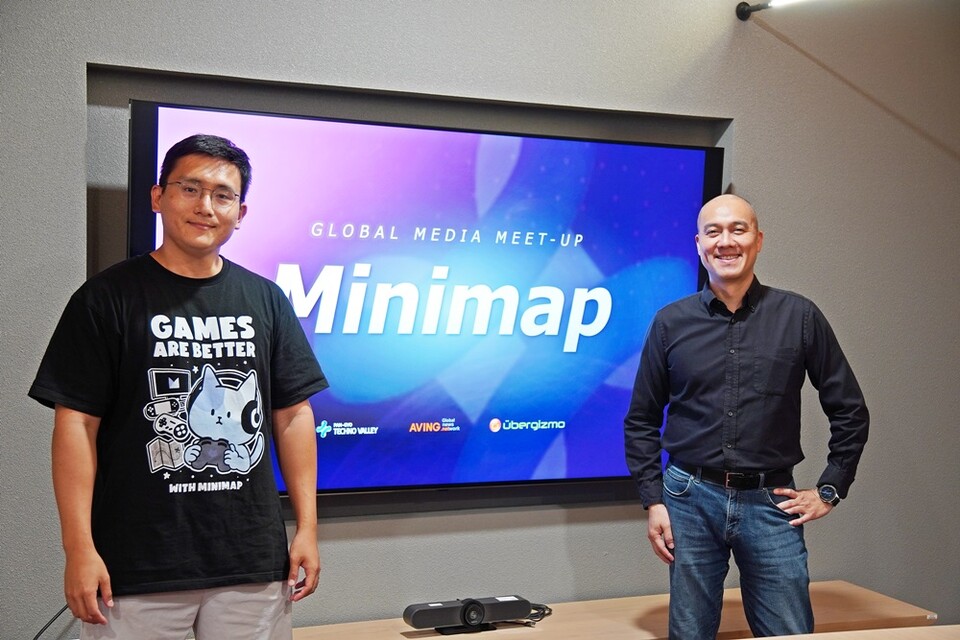
Photo courtesy of Aving.net
Minimap began beta service in South Korea in 2017 and later launched an English-language service. It now describes itself as a global gaming community and lists Sony Interactive Entertainment, Sega, Capcom, 2K, and SNK among its partners.
The company’s next challenge is product focus. During our conversation, Jeong discussed a real cultural difference: Korean users may be more comfortable with an all-in-one app, while U.S. users often prefer simpler products built around a single task. We’ve seen this in many places such as the Naver homepage in Korea, or the fact that Japanese users still like a very busy Yahoo homepage.
Minimap is reportedly considering a more streamlined global interface and potentially separate products for specific features, which could be a great way to address different regional preferences
Filed in . Read more about Korea and Korean Startups.