 A wellness product can sound simple until it has to cross a border. The same supplement formula may need a different dose, label claim, price, manufacturing setup, or sales channel depending on where it is sold. Miss one dependency, and a company can discover a problem only after it has substantially spent on product development and production planning.
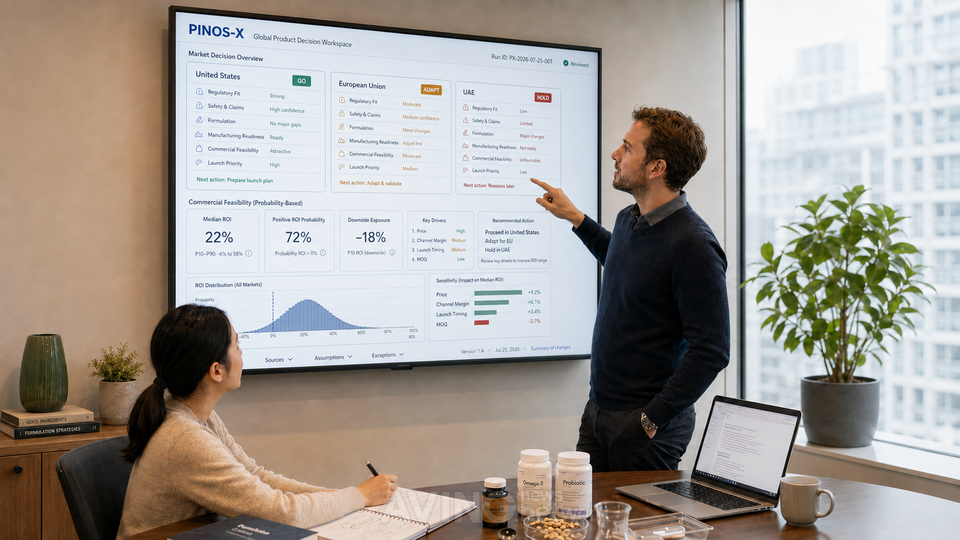
That is the risk Pinos Korea wants to address with PINOS-X, a B2B decision-support platform for companies developing and launching wellness products internationally. The company says the software is meant to connect the inputs that teams often handle separately: scientific evidence, ingredients, regulations, formulation, manufacturing readiness, pricing, distribution margins, and country-by-country launch plans.
Worldwide dietary supplements are not governed by one universal rulebook. In the U.S., manufacturers and distributors are responsible for ensuring a supplement’s safety and labeling before it reaches the market, while the U.S FDA can take action against products that are misbranded. Canada takes a different approach for natural health products, requiring product licences and, for relevant activities, site licences.
For a smaller brand it means that a decision about an ingredient or a marketing claim can affect manufacturing, unit economics, and launch timing. Pinos Korea’s argument is that those potential effects should be modeled before a company commits much of its budget.
I met CEO Howard Han Do Kim in person at a July media gathering in Seoul. He framed PINOS-X to put the real tradeoffs of a launch into one decision process. A brand might want to sell a nutritional supplement in several countries, he said, but must account for varying regulations, consumer expectations, pricing structures, margins, and distribution channels at the same time.
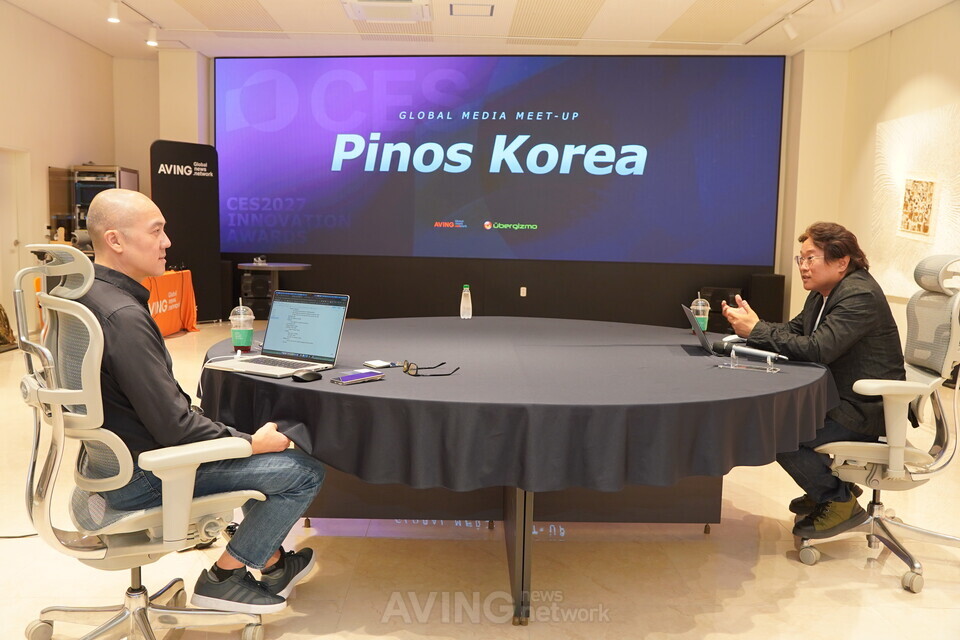
Pinos Korea CEO Howard Han Do Kim (right) during an interview with Ubergizmo Editor-in-Chief Hubert Nguyen | Photo by AVING News
The company says users would enter a product brief and its assumptions, then use PINOS-X to model options. The promised output is deliberately plain: proceed in a market, adapt the plan, or hold it. In the company’s terminology, those outcomes are GO, ADAPT, and HOLD.
Under the hood, Pinos describes a system that ties constraints together, so a change to an ingredient dose or permitted claim can force a review of the related product and business assumptions. The company uses eight analytical modules and runs at least 10,000 simulations for a scenario. It also says each analysis receives a “Run ID” recording sources, assumptions, risks, alternatives, and exceptions.
That auditability is potentially the most interesting part of the pitch. Generative AI is good at producing plausible explanations, but a business making a regulatory or manufacturing decision needs to know which assumption changed and who should review it. A durable record is critical, especially when a product team has to explain why it abandoned or modified a plan.
The company’s current revenue comes from professional services, while PINOS-X subscriptions and licences are not yet producing product revenue. The startup’s experience workflow is the foundational piece of the puzzle, but the AI automation can achieve scale.
Pinos Korea says it was established in 2024 and has worked on health and biotech commercialization services, including market-entry strategy and feasibility assessments. Its public site describes a broader role: connecting science, product design, compliance, economics, and market entry before a company makes costly commitments.
The company is targeting a first commercial launch of PINOS-X in January 2027 and plans to demonstrate multi-country launch scenarios at CES 2027. It says it is prioritizing review of the U.S. and Canada, followed by markets including Australia, Germany, Malaysia, and Vietnam.
Filed in . Read more about Business, CES 2027, Korea and Korean Startups.