Startups do not usually fail because nobody gives them a desk. They fail because the right engineer, buyer, researcher, investor or test environment is just out of reach when the company needs it most.
That is one of my key takeaways after visiting Pangyo Techno Valley, Korea’s large technology cluster south of Seoul. The location is often compared with Silicon Valley, but the more useful comparison is not about famous companies or startup valuations. It is about physical design.
Pangyo puts young companies, established tech firms, accelerators, public-sector support staff, research organizations and specialized facilities in close proximity. The goal is to reduce the friction between having an idea and proving it works outside a slide deck.
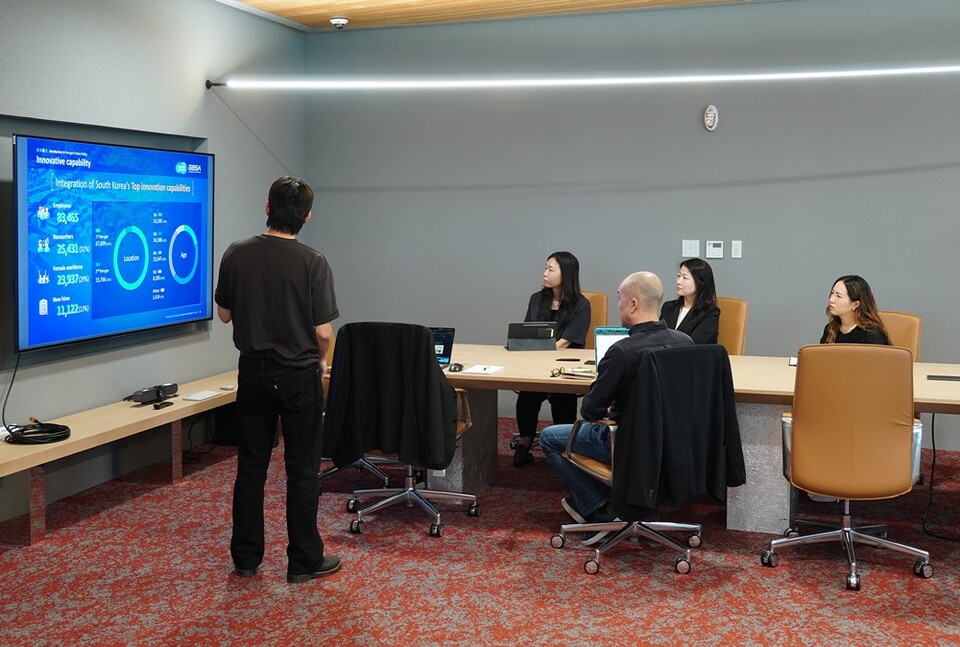
During a recent visit, I met with officials from the Gyeonggido Business & Science Accelerator, or GBSA, at the Pangyo Startup Campus. GBSA is not a startup or an investment fund. It is a public, nonprofit agency that supports businesses in Gyeonggi Province and helps operate parts of the Pangyo ecosystem.
The most interesting part of the conversation was not that GBSA offers startup office space. Plenty of places do that. It was the idea that a startup’s physical location can become an operating advantage when it puts the company close to people and facilities that can help answer expensive questions:
- Can/how this product be tested?
- Is there a research partner who understands the problem?
- Can someone introduce the team to a pilot customer?
- Is there public support available before the company burns another six months of runway?
In the West, startup support is often scattered. An accelerator may be downtown, a university lab may be across town, a corporate partner may be in another state, and a government program may be administered through a separate agency with little day-to-day contact with founders. It is effective, Silicon Valley itself proves it, but it creates more coordination and requires more network power for the startup.
Pangyo’s model is more intentionally concentrated. GBSA officials described a campus that brings together startups, 19 accelerators and support institutions, with research organizations nearby. The agency’s public Startup Campus program supports prospective founders and technology startups up to seven years old, separating its space offerings across pre-startup, early-stage and growth-stage companies. ( see GBSA’s Startup Campus program)
A team with only an idea does not need the same help as a company with early revenue, and neither needs exactly what a more mature deep-tech company needs. Deep-tech startups, in particular, can spend years moving from concept to a working demonstration because access to equipment, specialists and credible test environments is limited.
GBSA officials said they run public proof-of-concept projects that select roughly 20 to 30 companies, give them access to relevant facilities for six months to a year, and provide up to KRW 20 million in support. Those are interview-sourced program details, not available to every applicant. For those who have access, it may unlock a demonstration, experiment or technical relationship that a small startup could not arrange alone.
This is where physical density becomes more than real estate or convenience. A startup campus is useful when being there shortens the path to a researcher, an accelerator, a public testbed or an enterprise conversation. The value is to shorten and accelerate the iteration loop through which all great startups use seeking the perfect product.
The agency is also trying to orient that model around the next set of technology priorities. Officials said Gyeonggi Province is emphasizing AI, while related programs are still being developed. They also said a fabless-specialized district is under discussion.
Fabless companies design semiconductors but outsource manufacturing, avoiding the enormous cost of owning a chip fabrication plant (like NVIDIA). Both ideas should be treated as plans, not completed Pangyo initiatives, but they show an effort to direct the cluster toward AI, advanced mobility and semiconductor-related work.
There is also a limited but potentially useful lesson for foreign founders. GBSA officials said there was no U.S. company on the campus at the time of our meeting, and I don’t think there’s a formal landing program for overseas startups.
However, a foreign company with a Korean market question, an R&D need, a manufacturing connection or a partnership thesis could reasonably reach out and see whether there is synergy with the local ecosystem, in my opinion.
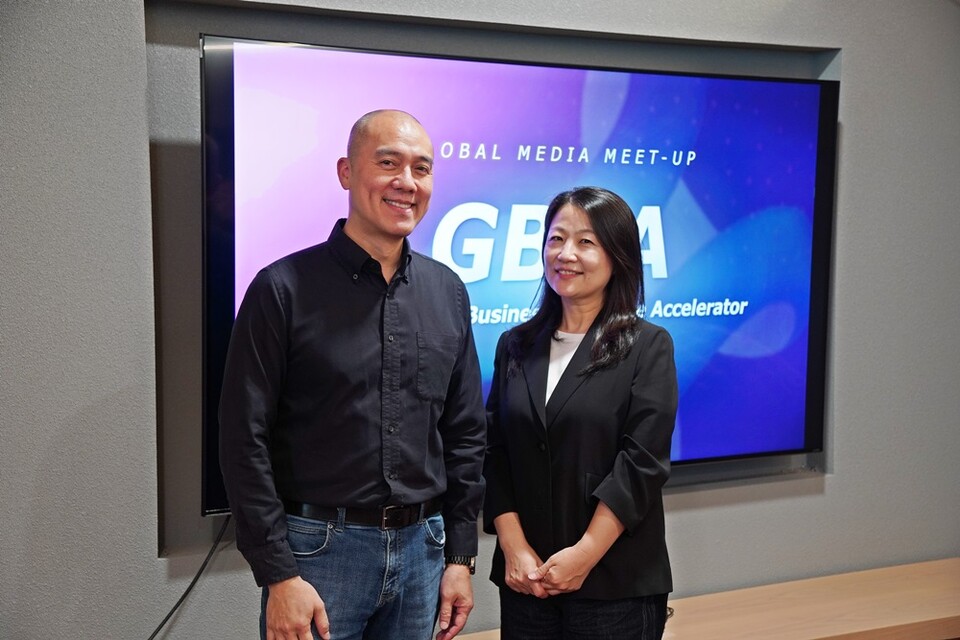
(From left) Ubergizmo Editor-in-Chief Hubert Nguyen and Techno Valley Innovation Group Director So Yeon Lee take a commemorative photo after concluding the meetup. | Photo by AVING News (https://us.aving.net)
GBSA already runs outward-facing support for Pangyo startups, including global acceleration, overseas commercialization funding, translation and interpretation in English, Chinese and Japanese, and investor-startup exchanges.
Its published program lists support for 12 globally promising startups through acceleration, commercialization support for 20 tenant startups, 350 language-support cases and four investment-exchange events.
That activity is mainly designed to help Korean companies go abroad, particularly toward the U.S. market. But the same connections can matter to foreign investors, accelerators, university labs and companies looking for Korean technology partners.
In the end, buildings do not create innovation, and a campus can become an expensive real-estate project if its managers do not convert proximity into genuinely useful connections and outcomes.
For founders out there, do not ask only whether an ecosystem has money or prestige. Ask whether it can help you make the next (very) expensive decision faster.
Filed in . Read more about Korea and Korean Startups.