Hugging Face has introduced Microduck, a compact, bipedal robot designed to make artificial intelligence and robotics accessible to both casual users and developers. Standing approximately 10 inches tall, the duck-shaped device features a distinctive design characterized by a waddling gait and an articulated beak capable of grasping objects.
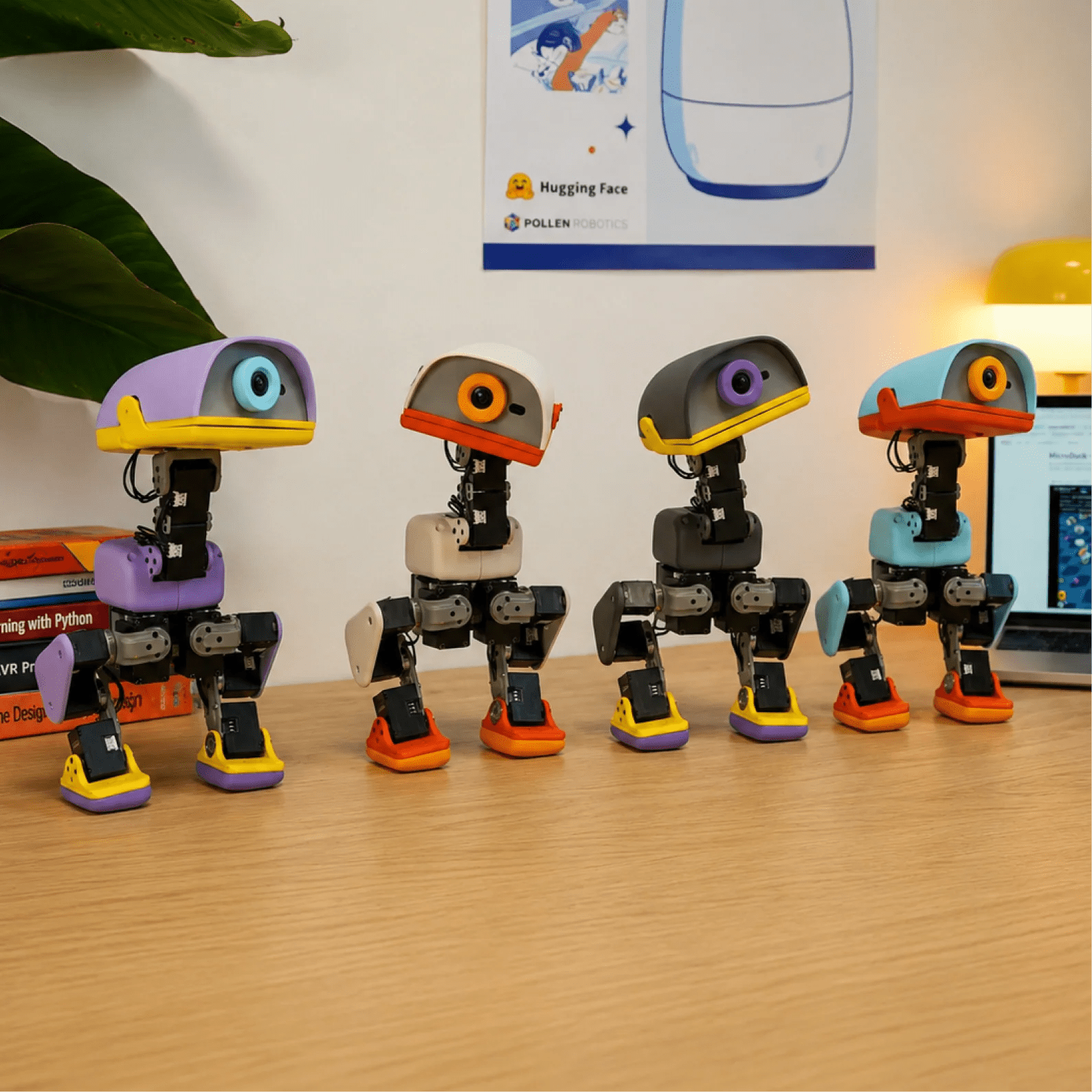
Hardware specifications include 15 motors, an integrated camera, a depth sensor, and two inertial measurement units (IMUs) for navigation and balance. Out of the box, Microduck supports various pre-programmed behaviors, including walking, sitting, crouching, and skating. Users can control the device using a gamepad, have it track a laser pointer dot, or let it autonomously interact with surrounding objects.
Beyond its consumer applications, Microduck functions as a flexible robotics development platform. The device runs an open-source software stack, allowing programmers to train new skills and behaviors via reinforcement learning, direct code programming, and simulation tools. Hugging Face has launched public repositories to support these workflows, including a dedicated environment containing reinforcement learning libraries and digital simulation environments.
Microduck marks the second hardware release from Hugging Face, following the Reachy Mini, a desktop-focused platform intended for conversational AI, computer vision models, and human-robot interaction research. In contrast to the research-centric focus of the Reachy Mini, Microduck offers a more lighthearted design and expanded styling options.
The robot is available for pre-order directly through the manufacturer’s website, priced at $399. It comes in four distinct colorways: Cream, Graphite, Lavender, and Sky. Initial shipments are scheduled to reach customers in North America, the United Kingdom, and Europe ahead of the winter holiday season.
Filed in . Read more about AI (Artificial Intelligence) and Robot.