Generative AI has made it much faster to produce a screen, mockup, or visual concept. But it has not solved the part of product design that often takes the longest: getting a team to agree on what to keep, what to change, and why.
That is the business opportunity that Takeanap sees. Its product, D:bo, is not positioned as another AI generator for images or interfaces, at all. Instead, the South Korean startup wants to capture the decisions, feedback, and revision intelligence that accumulate after a design is generated, then turn that material into reusable team knowledge.
The company’s premise is easy to understand if you have worked inside a product organization. A designer may receive comments in Figma, a product manager may explain a change in Slack, and a leader may make the final call during a meeting. Weeks later, the team remembers the result but not always the reasoning. The next project starts, a similar disagreement returns, and people reopen work that was already settled.
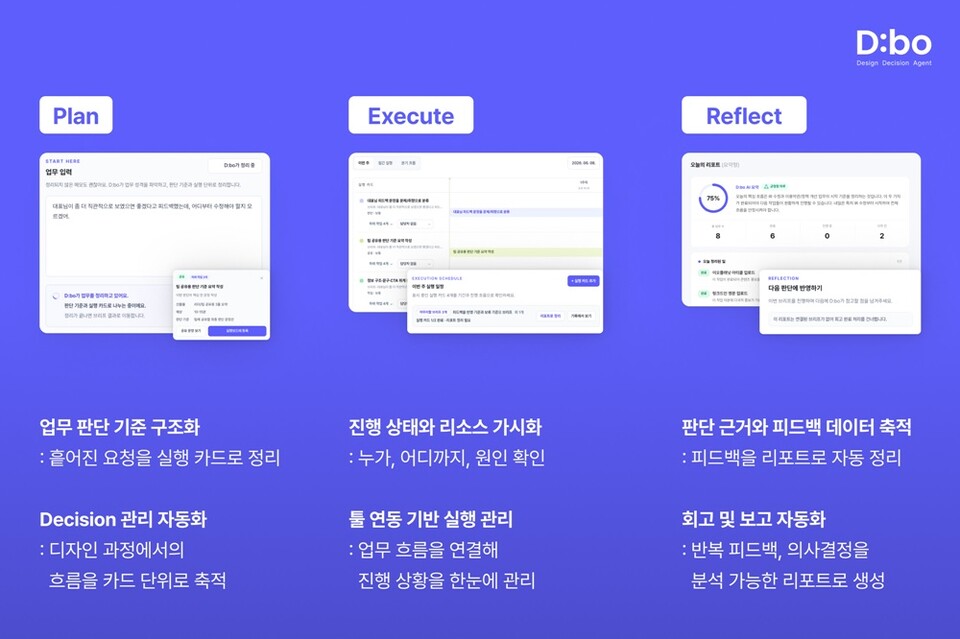
Takeanap says D:bo is meant to make that reasoning visible. The system is organized around a plan, execute, and reflect cycle. In the planning phase, it structures a request around context and scenarios. During execution, the company says it follows the work and decisions that emerge across a team’s workflow. In the reflection phase, it turns feedback and outcomes into reports that can inform the next project.
To me, the strongest part of this story is not the AI. It is where the product came from.
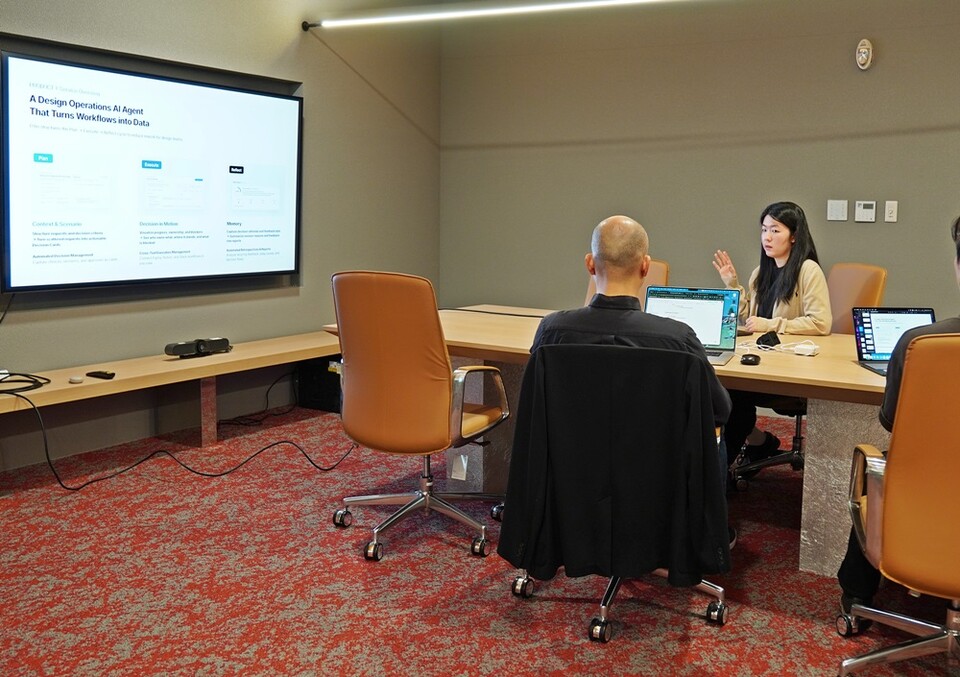
I met Takeanap CEO Saemi Jung in person at the 2026 Pangyo Global Media Meetup, where she explained that the company grew out of her experience working across design, development, and marketing. She had seen the problem from inside the workflow: creating an output can be quick, but deciding whether that output is right and communicating the reason to everyone involved is not easy.
Many durable companies begin when a founder knows a problem well enough to recognize what existing products are missing. Jung’s insight is that generative AI may accelerate individual production without accelerating organizational judgment.
When I asked about the gap, the conversation kept returning to the same point: a team’s productivity does not automatically rise at the same rate as an individual’s AI-assisted output. If an AI tool generates ten viable directions instead of two, the team still needs to choose among them. In some cases, more options can create more review work, not less.
D:bo’s proposed answer is to preserve the “why” behind those choices instead of treating design feedback as a pile of comments or asking employees to write more documentation. Takeanap wants to structure information that already arises during work: requests, feedback, changes, decisions, and project outcomes.
The company calls the long-term version of that record “design decision DNA.” The name is a little ambitious, but the underlying idea is good. Teams do have distinct working patterns. One product group may prioritize speed, another accessibility, another visual consistency, and another customer feedback. Those preferences usually live in people’s heads, informal conversations, and the habits of experienced employees. It’s often called “institutional knowledge.”
If D:bo can capture that context accurately, it could become much more useful than a generic AI assistant that can summarize discussions. A decision-oriented system should be able to say what was decided, why it was decided, what evidence shaped the choice, and whether a similar question has already been resolved.
The challenge is that the product has to perform well enough to avoid becoming another administrative layer. Product teams already have more tools than they want. It’s all about saving time.
Takeanap is initially focusing on early Series A teams with design leaders, product managers, and product designers. The company says it plans to validate the service through a 60-day Design Decision Bootcamp, beginning with a two-week workflow diagnosis and followed by a six-week live proof of concept. It also says its earlier portfolio-feedback service accumulated more than 650 designer work datasets.
The company is also looking rightly beyond South Korea, with North America and other English-speaking markets identified as priorities. The target makes sense: distributed product teams already depend heavily on digital collaboration, which is precisely where decision history gets fragmented. Let’s see if the idea can go global and focus teams on building the right products, more efficiently.
Photos courtesy of Aving.net
Filed in . Read more about AI (Artificial Intelligence), Design, Korea, Korean Startups and Productivity.